
Surgical Site Infections: Understanding the Role of Airborne Contamination
Surgical Site Infections (SSIs) remain one of the most common complications associated with surgical procedures worldwide. Despite advances in sterilization protocols, antibiotics, and surgical techniques, SSIs continue to impact patient outcomes and place a significant burden on healthcare systems.
The causes of SSIs are complex and multifactorial. Patient-related factors such as immune status, comorbidities, and procedural complexity all contribute to infection risk. However, the operating room environment also plays a critical role, particularly when it comes to airborne contamination.
Airborne particles and infection risk
During surgery, particles are continuously released into the air from surgical staff, textiles, and equipment. Many of these particles are microscopic and can carry bacteria.
This relationship between airborne contamination and infection risk has been studied for decades, dating back to the pioneering work of Charnley, who demonstrated the importance of controlling airborne transmission of pathogens in surgical environments.
Moreover, one of the most influential studies in this field, conducted by Lidwell et al., demonstrated a clear correlation between airborne bacterial counts and the incidence of postoperative infections in joint replacement surgery. The study showed that reducing airborne contamination through improved ventilation could significantly lower infection rates.
Further research by Whyte et al. reinforced this understanding by demonstrating how human activity is the primary source of airborne particles in operating rooms. These studies also highlighted how airflow patterns influence the transport and deposition of bacteria-carrying particles.
Together, these findings established a fundamental principle: controlling airborne particles is a key component of infection prevention in surgery.
The limitation of airflow volume alone
Traditional ventilation systems, including laminar airflow (LAF), have focused on supplying large volumes of clean air to the surgical field. While effective under controlled conditions, real-world operating rooms present a more complex challenge.
Movement of staff, heat from equipment, and physical obstructions can disrupt airflow, leading to turbulence. When airflow becomes unstable, clean and contaminated air mix, reducing the effectiveness of the system.
This highlights an important shift in perspective: it is not only the amount of air that matters but how that air behaves.
A new approach: stable, low-turbulence airflow
Temperature-Controlled Airflow (TcAF) is a modern ventilation technology designed to address this challenge by focusing on airflow stability. By introducing slightly cooled, ultra-clean air, TcAF uses natural convection to create a downward, stable airflow pattern. Because the airflow is driven by temperature differences rather than high velocity, it is less sensitive to disturbances caused by movement or equipment.
This results in reduced turbulence and more consistent control of airborne particles across the operating room.
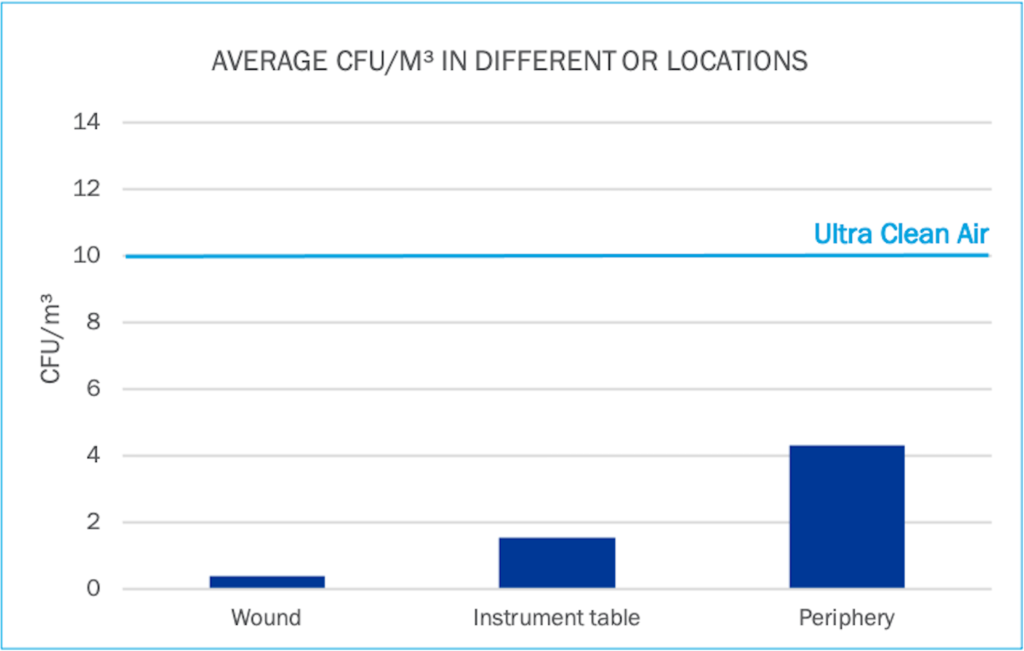
The unique Opragon system is proven to ensure ultra-clean conditions in the whole operating and prep room.
A comparative evaluation of the Opragon system with conventional ventilation schemes found TcAF
to be more effective in maintaining ultra-clean conditions of <10 CFU/m3 throughout the entire room during live surgery.
By maintaining stable airflow conditions, TcAF supports the principles established by Charnley, Lidwell and Whyte: minimizing airborne contamination and limiting the spread of bacteria-carrying particles.
Supporting a comprehensive infection prevention strategy
Ventilation alone cannot eliminate the risk of surgical site infections. However, it is a critical component of a broader strategy that includes sterile techniques, antibiotic protocols, and optimized surgical workflows.
What modern ventilation solutions offer is a more reliable way to manage airborne risks under real operating conditions, not just in theory.
As operating rooms continue to evolve, understanding and controlling airflow behavior will be essential in supporting safer surgical environments.
Interested in learning more about infection prevention in the operating room?
Discover how Temperature-Controlled Airflow (TcAF) supports stable, low-turbulence environments for cleaner surgical conditions.