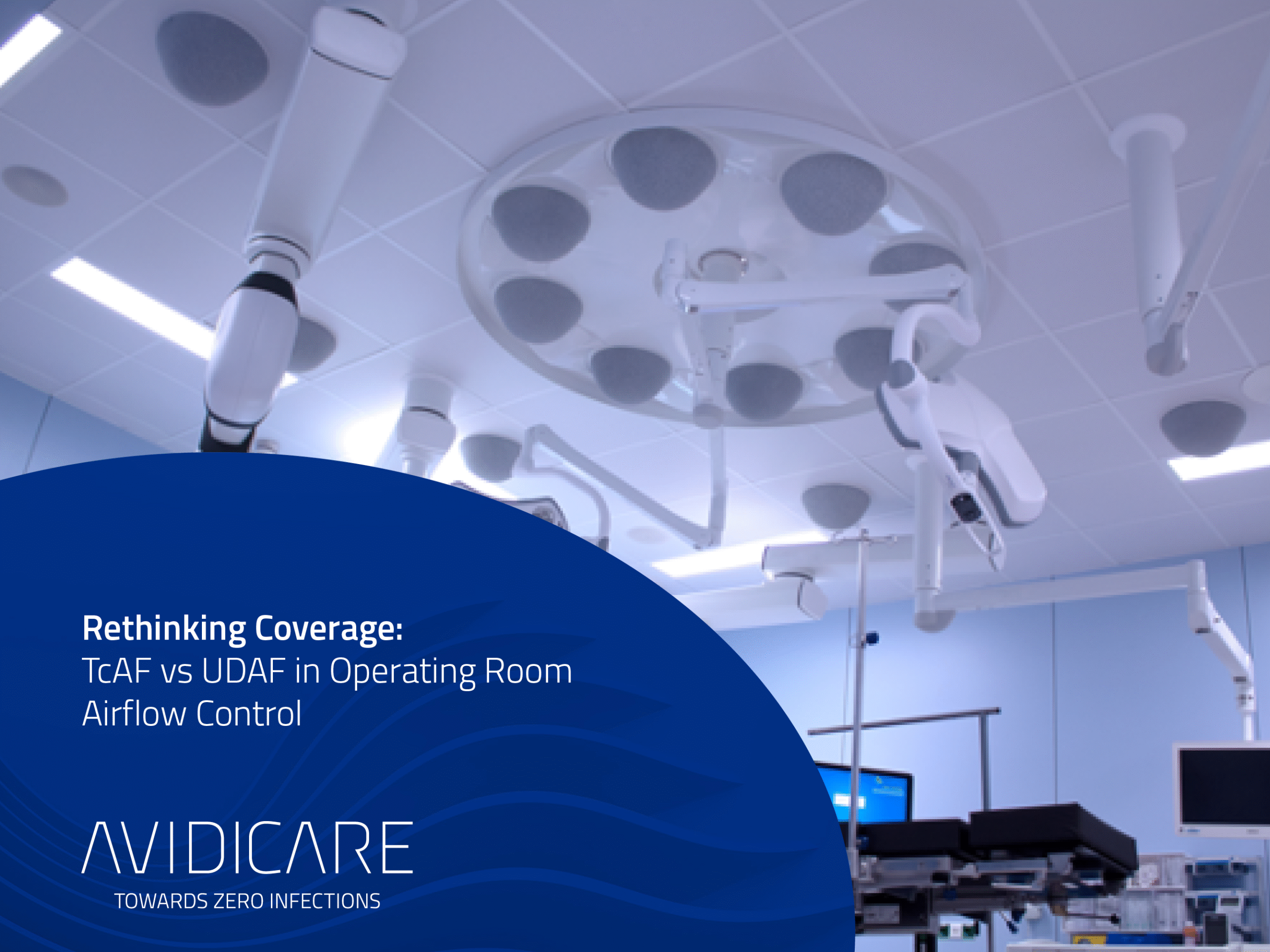
Rethinking Coverage: TcAF vs UDAF in Operating Room Airflow Control
Series Introduction
This article is the first in a series exploring common misconceptions surrounding Temperature-controlled Airflow (TcAF) in operating room design. Aimed at technical consultants and hospital architects, the series examines each claim in detail and compares TcAF to traditional Unidirectional Airflow (UDAF, often called LAF) systems using both scientific data and real-world experience. The objective is to support informed decision-making in infection-sensitive environments through a deeper understanding of airflow design principles.
Claim: “UDAF protects a larger ultra-clean area over the patient.”
Reality: TcAF controls the entire OR environment, while UDAF primarily protects the core zone directly beneath its high-velocity flow.
Context and Analysis
In many OR designs, UDAF systems are implemented with the intent of creating an ultra-clean zone by pushing high-velocity air vertically over the surgical field. However, this approach creates a limited clean core surrounded by areas vulnerable to turbulence and recirculation, conditions where bacterial contamination can accumulate, especially near the edges where equipment and personnel are often positioned.
TcAF offers a fundamentally different approach. Rather than only concentrating airflow in a single vertical column, it distributes HEPA-filtered, temperature-controlled air throughout the room. This results in a stable downward displacement that keeps the entire OR environment, central and peripheral, below the commonly accepted contamination threshold of 10 CFU/m³. Measurements consistently show levels below 5 CFU/m³ throughout the room and under 1 CFU/m³ in the wound zone.
By controlling airflow across the full OR, TcAF minimizes variability and ensures that airborne contaminants are displaced, not merely diluted, wherever they arise.

Conclusion
While UDAF concentrates protection in a central zone, TcAF is designed to maintain ultra-clean conditions throughout the entire operating room. For environments where contamination control is critical, this broader and more stable coverage offers a compelling advantage.
This is the first post in our series addressing common claims about TcAF. Stay tuned for the next post, where we explore the relationship between airflow volume and contamination control.