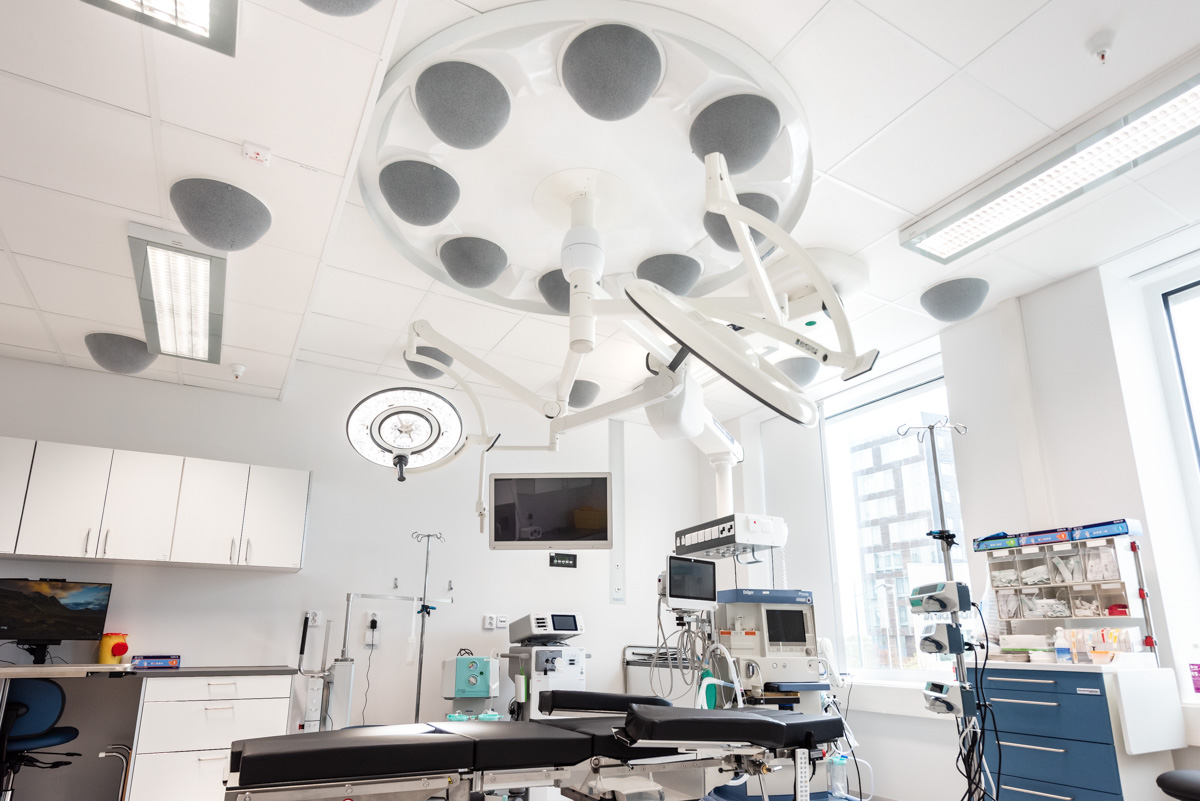
The Operating Room of the Future: Why Ventilation Matters More Than Ever
Operating rooms are among the most demanding environments in any hospital. Every detail matters. Surgical precision, advanced technology, and strict hygiene protocols must work in perfect harmony to protect the patient.
Yet one critical factor is often underestimated: airflow behaviour.
In reality, the air in an operating room is far from static. Every movement, whether from surgical staff, equipment adjustments, or door openings, generates airborne particles. These particles originate from skin cells, textiles, and materials, and frequently carry microorganisms that contribute to contamination risk.
The hidden challenge: turbulence
Traditional ventilation systems, such as laminar airflow (LAF), were designed to create a protected zone above the operating table by pushing clean air downward in a unidirectional flow.
In controlled conditions, this works well.
With larger surgical teams, advanced imaging systems, and constant movement, airflow is frequently disrupted. Equipment generates heat, staff move in and out of airflow zones, and obstacles interfere with the intended air patterns.
The result? Turbulence.
Instead of maintaining a stable downward flow, the air begins to mix. Clean air and contaminated air interact, increasing the risk that particles spread beyond their intended boundaries.

A different approach: controlling airflow through physics
To address this challenge, new ventilation strategies are rethinking how airflow is generated and controlled.
This is why we invented Temperature-Controlled Airflow (TcAF), the technology behind Opragon.
Instead of relying on high-velocity air to force contaminants away, TcAF uses temperature gradients to guide airflow naturally.
Slightly cooled, ultra-clean air is introduced into the operating room. Because cooler air is denser, it moves downward in a stable, uni-directional flow. This creates a controlled air distribution that is less sensitive to disturbances from staff movement or equipment.
Rather than breaking down under real-world conditions, the airflow remains consistently stable.

From protected zones to protected environments
This shift in airflow design enables a broader level of protection.
Instead of focusing solely on the surgical field, Opragon creates ultra-clean air across a significantly larger area of the operating room. This reduces the spread of airborne particles throughout the space and supports a more robust infection prevention strategy with a more flexible workflow.
At the same time, the system operates with lower airflow volumes compared to traditional solutions. This leads to reduced energy consumption, an increasingly important factor as hospitals work to meet sustainability and cost targets.
Innovation at the intersection of safety and sustainability
The operating room of the future must meet two critical demands:
- Maintain the highest standards of air cleanliness
- Reduce environmental impact, energy use and cost
By addressing the root cause of airflow instability Opragon offers a new way forward. Opragon moves beyond simply increasing airflow and instead focuses on controlling it.


Rethinking ventilation in modern surgery
As surgical environments continue to evolve, ventilation can no longer be seen as a background system. It is a central component of both patient safety and operational performance.
Understanding how air actually behaves in real operating rooms, not just in theory, is key to designing safer environments.
Curious about how airflow design can make a difference?
Please contact us to discover how Opragon and Temperature-Controlled Airflow create ultra-clean, low-turbulence environments for modern operating rooms.