
Are all ultra-clean ventilation systems windy and drafty?
When people first hear about ultra-clean operating room ventilation, they often imagine strong air currents, noticeable drafts, and uncomfortable working conditions for surgical staff.
But that’s not how Opragon works.
The Myth
“Opragon creates a windy operating room because it uses unidirectional airflow to control contamination.”
This assumption is understandable. Many conventional ventilation strategies rely on high air volumes and high air change rates to dilute and remove airborne contaminants. As a result, staff may associate effective contamination control with noticeable airflow.
The Reality
Opragon takes a different approach.
Rather than relying on high speed and large volumes of air to sweep contaminants away, the system uses temperature-controlled airflow and gravity-driven principles to gently guide clean air where it is needed most. This creates a controlled downward movement of air in critical zones without generating the drafty sensation often associated with high-velocity ventilation systems.
The result is an operating room environment designed to combine two important goals:
- Ultra-clean air in the whole room
- A comfortable working environment for surgical teams1
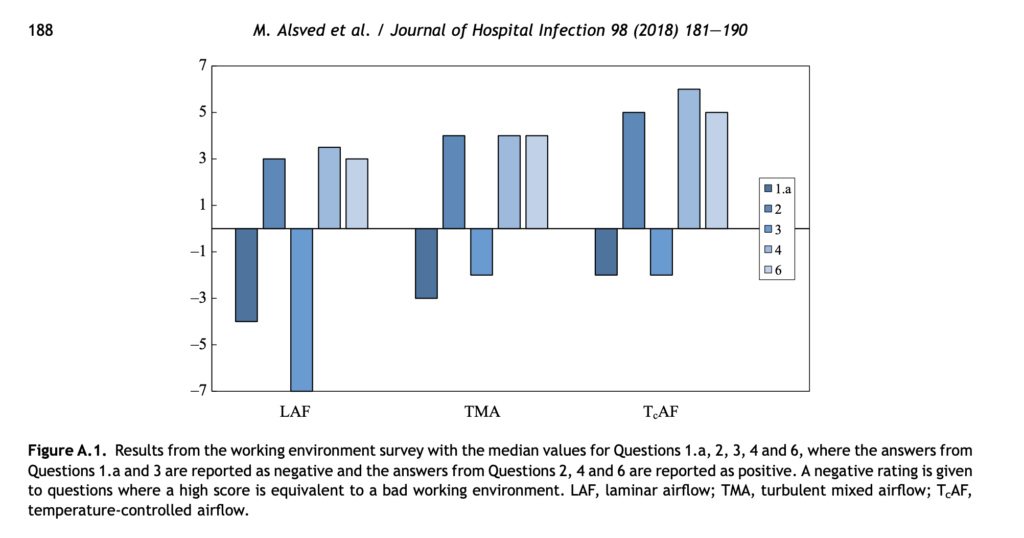
Questions Figure A.1
1. a. Do you perceive a cold draught from the ventilation in the room? 1 = Not at all, 7 = Very much
2. How do you perceive the temperature control in the room? 1 = Very bad, 7 = Very good
3. What is your perception of the noise from the ventilation? 1 = Very silent, 7 = Very loud
4. What is your overall perception of the ventilation in the operating room? 1 = Very bad, 7 = Very good
6. How do you perceive the overall working environment comfort in the room? 1 = Very bad, 7 = Very good
Why Comfort Matters
Operating room personnel spend many hours under demanding conditions. They need to remain focused, and they must be able to properly hear each other. Many ultra-clean ventilation systems fail this challenge, and hospitals need to choose if they want patient safety or staff comfort.
By minimizing unnecessary air movement while maintaining effective contamination control, Opragon helps create an environment that feels calmer, quieter and more comfortable for the people who work in it every day.
Looking Beyond Air Changes
For decades, ventilation discussions have often focused on air change rates. While air changes remain an important design parameter, they do not tell the whole story.
The effectiveness of a ventilation system depends not only on how much air is supplied, but also on how that air behaves within the room and around critical sterile zones.
Opragon’s design philosophy is based on controlling airflow patterns rather than simply increasing airflow volumes, helping achieve cleanliness in the whole room and comfort at the same time.
The Bottom Line
Effective contamination control doesn’t have to mean a windy operating room. Effective contamination control isn’t just about moving more air; it’s about moving air intelligently.
By leveraging temperature-controlled airflow and gravity, Opragon demonstrates that ultra-clean air and staff comfort can go hand in hand.
Sometimes the best ventilation is the one you barely notice.
1 M. Alsved et al (2018) – https://www.journalofhospitalinfection.com/article/S0195-6701(17)30579-0/fulltext